Welcome~Kholee Blast - Kholee Industrial Technology Yancheng Co., Ltd
 |
|

|
|
An abrasive Vacuum Recovery system is an industrial material recovery solution designed to collect spent abrasive after abrasive blasting operations. By recovering and transferring reusable abrasive back to the recycling or blasting system, it can reduce manual cleaning, improve abrasive utilization, and create a more efficient blasting workflow.
For shipyards, marine offshore, oil & gas, steel fabrication plants and heavy-duty surface preparation applications, abrasive vacuum recovery can be an important part of a complete abrasive recycling system.
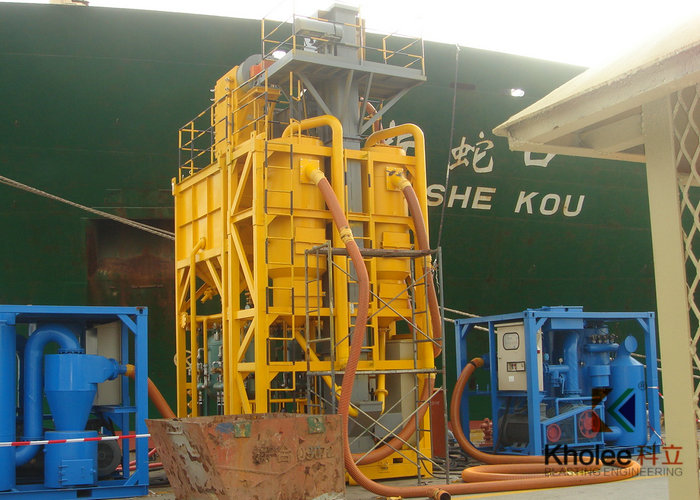
An abrasive vacuum recovery system uses a high-capacity industrial vacuum unit to collect blasting abrasive media from ballast tank of vessel, petro-chemical tank, floor or designated recovery area of a blast room after blasting cleaning.
The recovered material is normally transported through abrasion-resistant PVC hoses to abrasive collecting silo powered by vacuum pump.
A typical system may include:
● Vacuum pump
● Heavy Duty Electrical Motor
● Cyclone Separator
● Pulse Jet Dust Collector
● Vacuum Gauge
● Pressure Relief Valve
● Electrical & Pneumatic Control System
● Discharge Silencer
● Abrasive Collecting Silo
● PVC Grit Hose
● PVC Vacuum Hose
● Floor Suction Tools
The basic working principle is straightforward:
Blasting → Abrasive accumulation in Floor → Vacuum Suction → Abrasive Separation, Cleaning, Storage → Dust Filtering
During blasting, abrasive media hits the workpiece and removes rust, scale, paint, and other contaminants. Some abrasive remains reusable, while other material becomes broken-down abrasive, dust, or waste.
The vacuum recovery system collects this mixture from ballast tank of vessel, petrochemical tank or floor of huge blast room.
After blasting, the operator uses a PVC grit hose, floor suction tool to collect abrasive from the working area.
A powerful vacuum pump creates negative pressure and moves the abrasive-air mixture through the PVC grit hose.
The recovered abrasives enters a silo where heavier abrasive particles are separated from lighter contaminants and dust. Dust, paint chips, rust, and other contaminants are removed with airflow to cyclone and dust collector of vacuum recovery system.
The airflow with dust will enter dust collector and get filtered.
The recovered abrasive can be returned to the blasting machine for continued use.
This closed-loop process helps reduce abrasive consumption and minimizes the amount of waste that must be manually removed from the blast room.
Traditional abrasive cleaning can require significant manual labor, particularly when large quantities of steel grit, garnet, copper slag accumulate on the floor of vessel, petrochemical tank or blast room. The conventional method of recovering spent abrasives is both labor intensive and time consuming, while the fastest and most cost-effective method of cleaning up spent abrasives is by vacuuming recovery.
An abrasive vacuum recovery system provides several advantages.
Operators do not need to manually shovel large quantities of abrasive after every blasting operation.
High-capacity vacuum recovery equipment can significantly accelerate abrasive collection
Reusable abrasive can be recovered and returned to the blasting process instead of being discarded.
Recovering reusable steel grit can reduce unnecessary abrasive losses.
The system can be integrated with dust collection equipment to help control airborne dust and contaminants.
Faster abrasive recovery means less downtime between blasting operations.
The vacuum recovery system should be designed according to the abrasive type, particle size, density, contamination level, and blasting process. Common recoverable materials include:
● Steel grit
● Garnet
● Copper Slag
The recovery equipment must therefore be designed to handle the required abrasive flow without excessive blockage, wear, or pressure loss.
The system should be engineered according to the actual application.
Important parameters include:
1. Blast room dimensions, Ballast Tank Depth and Petrochemical Tank Diameter
The size of blast room, depth of ballast tank and diameter petrochemical tank determines length of PVC hose required and height of vacuum recovery system will be placed.
2. Abrasive type
Steel shot, steel grit, Cut Wire Shot, and mineral abrasive have different densities and conveying characteristics.
3. Abrasive size
Particle size affects suction requirements and pipeline performance.
4. Recovery capacity
The system should be designed according to the amount of abrasive that must be recovered per hour.
5. PVC hose length
Longer pipelines create additional pressure loss.
6. Vertical conveying height
If abrasive must be lifted to a separator or elevated hopper, additional vacuum capacity is required.
7. Number of recovery operators
One-operator and multi-operator systems require different vacuum capacities.
8. Abrasive recycling requirements
A supplier can then calculate and recommend the appropriate vacuum recovery system 132W, 90KW, 75KW, 45KW or 37KW
Abrasive vacuum recovery systems are commonly used in:
Vacuum recovery is particularly useful in shipyard and huge blast room where blasting abrasives recovery is trouble and heavy duty work
A1: It is an industrial vacuum-based system used to collect spent blasting abrasive from a blast room, ballast tank of vessel, petrochemical tank and transport it to a separator, cleaner, or recycling system for reuse or disposal.
A2: Yes. Vacuum recovery systems can be designed specifically for steel shot and steel grit. Because steel abrasive is heavy and highly abrasive, the vacuum capacity, hose diameter, pipeline, and wear-resistant components must be properly selected.
A3: It can reduce abrasive waste and manual cleaning labor by recovering reusable abrasive and returning it to the blasting process.
A4:Yes. One of the main advantages of vacuum recovery is its flexibility for retrofit applications where installing a permanent floor recovery system may be difficult.
A5: The vacuum recovery system can collect abrasive and contaminated material, while a properly designed dust collector captures fine airborne dust. The vacuum recovery system and blast-room ventilation/dust collection system should therefore be considered together.
An abrasive vacuum recovery system is more than a simple industrial vacuum. When properly engineered, it becomes an important part of a complete abrasive recycling system for blast room, tank of vessel and.
The ideal system should match the abrasive type, blast-room dimensions, diameter of petrochemical tank, depth of ballast tank, recovery capacity, conveying distance and dust-control requirements.
For applications using steel shot, steel grit, an integrated solution combining vacuum recovery, abrasive separation, abrasive cleaning, dust collection, and abrasive storage can provide a more efficient and sustainable blasting operation.
Contact:Carl Chen
Phone: +86-139 1469 8671
Email:kholeeblasting@gmail.com
Add:Dalong Industrial Park, Xituan, Dafeng, Yancheng, Jiangsu, China 224125
We chat